
How Office Space Influences Client Perception

Updated: March 4th, 2026
Published: January 5, 2026
In 1851, the Crystal Palace demonstrated that architecture itself could be an argument – Joseph Paxton’s radical glass structure in Hyde Park didn’t just house the Great Exhibition, it embodied the ambition and industrial confidence Britain wanted the world to recognise. The principle holds today, albeit in less spectacular terms. Your office space makes claims about your business before anyone reads your pitch deck or examines your credentials. The question isn’t whether clients form judgements based on your workspace – they do, immediately and unconsciously – but whether those judgements align with the impression you’re trying to create.
First Impressions Solidify Quickly
Clients begin evaluating your business the moment they enter your building. The reception area, the quality of finishes, the attention to spatial detail – these elements combine to create an impression that proves remarkably difficult to alter through subsequent interaction. Psychologists call this the primacy effect; in commercial terms, it means your office carries significant weight in how clients assess your credibility, stability, and attention to quality.
A well-considered workspace signals that you take your business seriously enough to invest in appropriate infrastructure. It suggests financial stability, organisational competence, and regard for detail. Conversely, shabby surroundings or obvious cost-cutting raises questions about whether similar economies extend to client work. Fair or not, clients extrapolate from physical environment to professional capability.
Location Carries Semantic Weight
A Mayfair address communicates differently than a Shoreditch one, which differs again from Canary Wharf. Location isn’t merely geographical – it’s semantic, carrying associations with particular business cultures, client types, and commercial positioning. Established professional services firms gravitate towards traditional business districts because the postcodes themselves signal permanence and establishment credentials.
This doesn’t mean all businesses should pursue premium locations regardless of fit. A creative agency might find Shoreditch’s cultural associations more valuable than Mayfair’s prestige. But the choice should be deliberate, acknowledging that clients read meaning into location whether you intend it or not. The alignment between your address and your brand positioning either reinforces your market position or creates dissonance that requires explanation.
Spatial Quality Reflects Operational Standards
Clients notice how your office functions, not just how it looks. Meeting rooms that work efficiently, technology that integrates seamlessly, creating a welcoming office reception that handles visitors professionally – these operational elements demonstrate organisational competence more convincingly than marketing materials ever could.
The inverse applies equally. Dysfunctional spaces – meeting rooms perpetually double-booked, unreliable WiFi, inadequate visitor facilities – suggest operational weaknesses that clients reasonably worry might extend to project delivery. If you can’t manage your own workspace efficiently, why should they trust you to manage their work?
Design Choices Signal Values
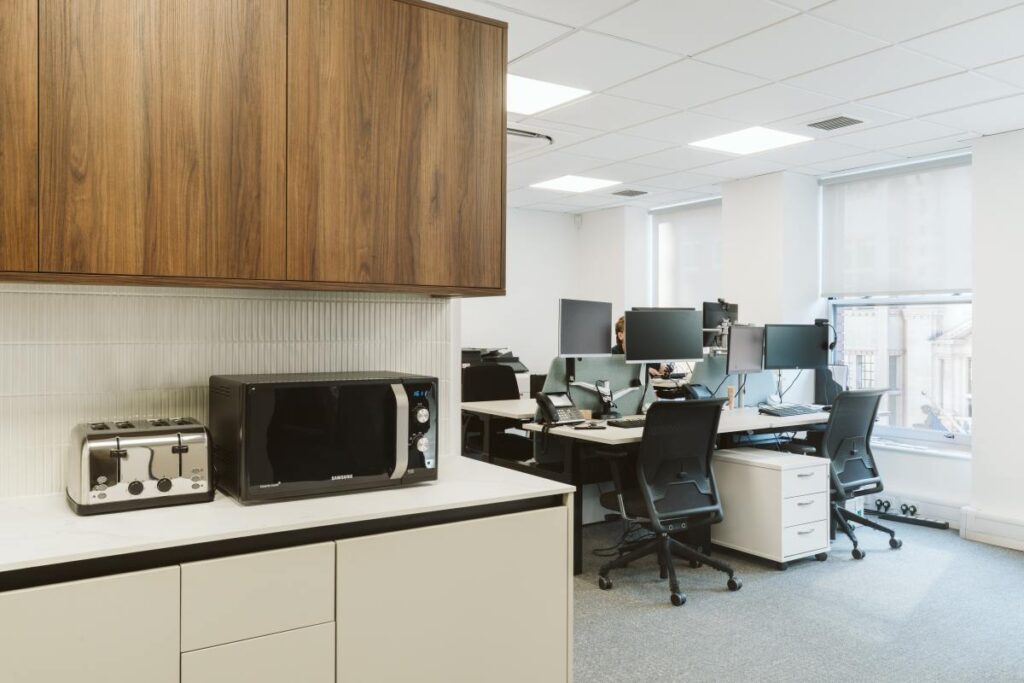
The aesthetic decisions embedded in your office communicate priorities and values. Minimalist design suggests efficiency and focus. Comfortable, residential-influenced spaces indicate concern for employee wellbeing. Sustainable materials and energy-efficient systems demonstrate environmental commitment. Clients who share these values respond positively; those who don’t may question whether your priorities align with theirs.
This extends to spatial allocation. Generous collaborative areas signal a culture valuing teamwork and knowledge-sharing. Private offices arranged hierarchically communicate traditional management structures. Open plans with minimal status differentiation suggest egalitarian cultures. These aren’t neutral choices – they reveal how your organisation actually operates, and clients form judgements about whether they want to work with that kind of company.
The Confidence Factor
Perhaps the most significant element office space communicates is confidence – not arrogance, but the quiet assurance that comes from occupying appropriate, well-maintained space. Businesses in unsuitable offices – too small, poorly located, visibly temporary – project uncertainty about their own futures. Clients notice this and factor it into risk assessments about engaging with you.
This doesn’t require extravagance. A modest but well-chosen office in an appropriate location, maintained to high standards and used efficiently, communicates competence and stability. The key is appropriateness – space that fits your business stage, sector norms, and client expectations. Overreach appears as obviously misguided as underinvestment.
When Perception Misaligns With Reality
The challenge emerges when your actual capabilities exceed what your office communicates, or when economic pressures force you into space that doesn’t represent your true market position. A talented consultancy operating from tired, outdated offices loses opportunities before demonstrating expertise. A growing business crammed into undersized space projects scrappiness rather than success.
This misalignment becomes particularly problematic in competitive pitches. When clients choose between firms of apparently similar capability, environmental factors influence decisions more than participants typically acknowledge. The firm presenting from a confident, professional environment holds an advantage that has nothing to do with technical competence but everything to do with the unconscious associations clients form.
The Investment Calculation
Treating office space purely as overhead misses its role in business development. The right space doesn’t just house your team – it actively contributes to winning and retaining clients. This doesn’t justify reckless expenditure, but it does warrant considering workspace as brand infrastructure rather than mere operational cost.
The calculation changes when you factor in client perception. A £10,000 annual increase in rent seems expensive until compared against the value of a single major client win, influenced partly by the confidence that your workspace projects. Professional services firms, in particular, benefit from this dynamic – their product is essentially their people’s expertise, making the environment where that expertise is demonstrated disproportionately important.
Making Workspace Work Strategically
At Soul Spaces, we provide professional assistance with office searches that considers client perception alongside operational requirements. The goal isn’t finding the flashiest available space but identifying locations and environments that authentically represent your business while meeting practical needs. This requires understanding both the commercial property market and the subtle signals different spaces send to different audiences.
Your office space makes arguments about your business whether you consciously design those arguments or not. The question is whether you’re controlling the message or allowing it to form by default, and whether the impression clients form aligns with the reality you’re trying to communicate.

Ready to find your dream office?