
How Managed Offices Reduce Operational Complexity

Updated: March 4th, 2026
Published: January 8, 2026
Most businesses occupy office space to enable work, not to become amateur property managers. Yet traditional leases transform tenants into de facto facilities operators – responsible for maintenance contracts, utilities procurement, cleaning services, security arrangements, technology infrastructure, and the endless administrative overhead these obligations generate. The complexity doesn’t add value to your core business. It simply diverts management attention and capital towards tasks that contribute nothing to competitive advantage.
Managed offices eliminate this burden by transferring operational responsibility to specialists whose business is running buildings efficiently. The arrangement isn’t novel – hotels have operated on similar principles for centuries – but its application to commercial office space offers particular advantages for businesses that recognise their expertise lies elsewhere.
The Hidden Cost of Self-Management
The direct costs of managing office space appear in budgets – utilities, cleaning contracts, maintenance agreements, insurance premiums. The indirect costs remain largely invisible but often exceed the obvious ones. Management time spent negotiating with service providers, handling building emergencies, coordinating repairs, managing contractors – these activities consume senior attention that could otherwise focus on revenue generation or strategic development.
There’s also the expertise deficit. Most businesses lack in-house facilities management capability, meaning they’re negotiating contracts, assessing service quality, and making technical decisions without specialist knowledge. This information asymmetry favours suppliers, resulting in suboptimal contracts and higher costs than experienced facilities managers would accept.
All-Inclusive Pricing Eliminates Budgetary Surprises
Traditional leases involve headline rent plus service charges, utilities, rates, insurance, and various other costs that fluctuate unpredictably. Budgeting becomes complex, and actual occupation costs often diverge significantly from initial projections. A building’s service charge might spike when major repairs become necessary. Utility costs vary with usage and market conditions. Insurance premiums shift based on factors beyond tenant control.
Managed offices typically operate on all-inclusive pricing where a single monthly payment covers everything – rent, services, utilities, technology, maintenance, the lot. This pricing transparency simplifies budgeting and eliminates the unpleasant surprises that accompany traditional leases. You know precisely what occupation costs monthly, making financial planning considerably simpler and removing the administrative burden of managing multiple supplier relationships.
Flexibility Matches Business Reality
Businesses rarely grow in predictable, linear patterns. Expansion might accelerate suddenly when major contracts are won. Headcount might shrink following project completions or market downturns. Strategic pivots might require different spatial configurations. Traditional leases, with their multi-year commitments and rigid terms, accommodate this variability poorly.
Understanding the operational benefits of flexible workspaces reveals how managed offices provide structural adaptability that conventional leases cannot match. Space can typically be increased or decreased with minimal friction. Lease terms operate on shorter cycles, preventing the common scenario where businesses find themselves locked into unsuitable space simply because breaking a conventional lease proves prohibitively expensive.
Professional Management Delivers Operational Excellence
Buildings managed by specialists simply function better than those where tenants handle facilities themselves. Professional building managers maintain preventive maintenance schedules that prevent small problems becoming expensive emergencies. They negotiate supplier contracts with the leverage of managing multiple properties. They handle regulatory compliance, health and safety requirements, and building certifications that most tenants barely understand.
This professional management extends to the occupant experience – reception services, visitor management, meeting room coordination, technical support. These services cost significantly more when procured individually than when amortised across an entire building. The economies of scale managed office providers achieve would be impossible for individual tenants to replicate.
Technology Infrastructure Without Capital Investment
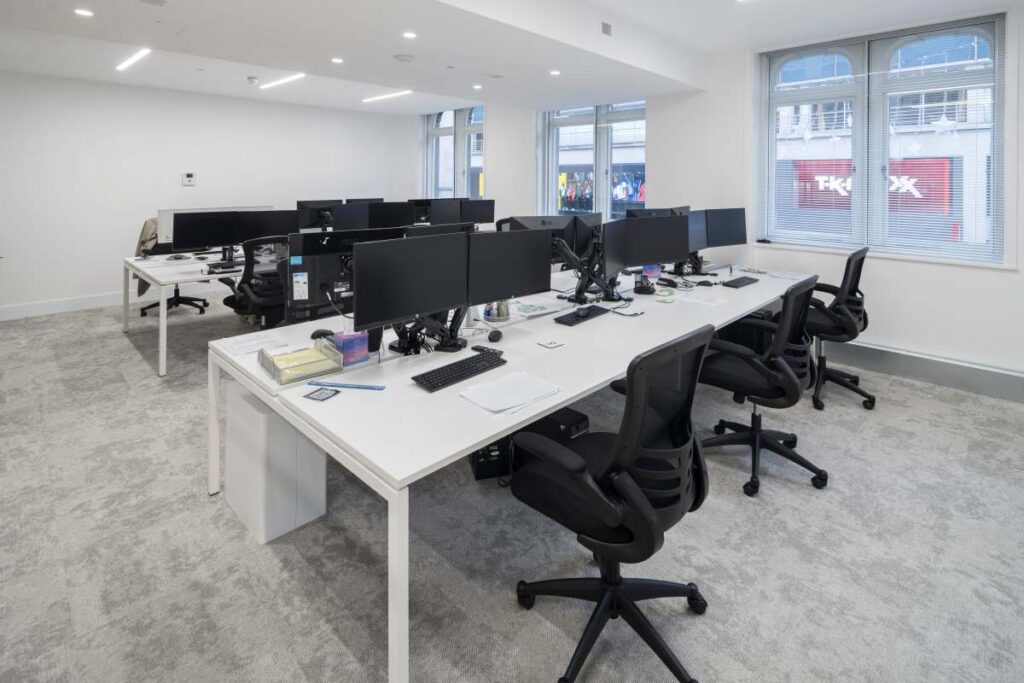
Establishing enterprise-grade technology infrastructure represents substantial capital expenditure – high-speed connectivity, robust WiFi throughout, integrated communications systems, meeting room technology, security systems. For businesses in conventional spaces, this means significant upfront investment in assets that depreciate rapidly and require ongoing maintenance.
Managed offices include this infrastructure as standard. You occupy space where the technology already exists, maintained, and regularly upgraded without requiring capital expenditure from you. When connectivity requirements increase or technology standards evolve, the building operator handles upgrades. Your business benefits from enterprise-grade infrastructure without the capital allocation or technical expertise those systems demand.
Faster Occupation, Simpler Exit
Traditional leases involve lengthy negotiations, detailed fit-out work, and extended timelines between committing to space and actually occupying it. Six months between signing and moving in isn’t unusual. Managed offices typically operate on much shorter cycles – weeks rather than months – because the space already exists in usable condition.
The exit proves equally straightforward. Conventional leases involve dilapidations negotiations, reinstatement obligations, and often contentious discussions about what constitutes fair wear versus tenant damage. Managed office agreements typically simplify or eliminate these complications, allowing businesses to exit cleanly when the arrangement no longer serves their needs.
When the Model Makes Sense
Managed offices aren’t universally optimal. Businesses requiring highly specific fit-outs, those with extremely particular spatial requirements, or organisations large enough to achieve economies of scale through self-management might find conventional leases more appropriate. But for most businesses, particularly those in growth phases or operating in sectors where agility matters, the operational simplicity managed offices provide outweighs the premium their convenience commands.
The calculation centres on whether your competitive advantage involves facilities management expertise. For the vast majority of businesses, it doesn’t. Your value proposition involves whatever you actually do – consulting, technology development, professional services, creative work – not managing property. Managed offices allow you to focus resources on what generates value rather than what simply enables basic operation.
Simplifying the Complex
For businesses seeking end-to-end managed workspace solutions, our team at Soul Spaces handles both the property search and ongoing management, ensuring operational complexity remains someone else’s problem. The value proposition is straightforward: your business does what it does well, whilst specialists handle the operational infrastructure that makes that work possible.
The best office space is the one you don’t have to think about – where everything simply works, reliably and professionally, without consuming management attention. That’s what managed offices deliver, and for most businesses, the premium that simplicity commands proves a bargain compared to the alternative.

Ready to find your dream office?