
How to Future-Proof Your Office Space
The Seagram Building, completed in 1958, remains remarkably functional sixty-seven years later – not because Mies van der Rohe could predict the future but because he designed for principles rather than passing fashions. Wide column spacing, generous floor-to-ceiling heights, robust infrastructure capacity – these decisions anticipated change without knowing its specific form. Contemporary office design faces similar challenges with considerably less certainty about what requirements will emerge even five years ahead.
Future-proofing doesn’t mean predicting what comes next. It means creating environments adaptable enough to accommodate whatever emerges, which requires thinking beyond immediate requirements to consider how workspace might need to evolve.
Infrastructure That Anticipates Growth
Technology requirements prove particularly unpredictable. Power demands that seem generous during installation become inadequate within three years as devices proliferate. Data infrastructure that appears robust proves constraining as digital operations expand. Cooling capacity sized for current equipment struggles when density increases.
The solution involves deliberate over-specification – provisioning power, data, and environmental systems beyond current requirements by margins that feel excessive during installation but prove essential within years. Additional electrical capacity costs relatively little during construction but enormous amounts to retrofit. Excess data cabling provides headroom for future needs you cannot accurately predict today. Oversized cooling systems accommodate increased loads without modification.
Spatial Configurations That Welcome Change
Fixed partitions, permanent furniture arrangements, inflexible spatial configurations – these decisions assume stability that contemporary business rarely exhibits. Teams expand and contract. Departmental structures reorganise. Working patterns shift. The workspace that optimises perfectly for today’s organisational chart becomes problematic within eighteen months when that structure inevitably changes.
Demountable partitioning systems, modular furniture, open floor plates with minimal permanent divisions – these elements cost marginally more initially but avoid the substantial expense of demolishing and rebuilding when spatial requirements evolve. The challenge is distinguishing between what must remain fixed and what should stay adaptable. Structural elements, core services, primary circulation require permanence. Nearly everything else benefits from flexibility.
Accommodating Unpredictable Work Patterns
The distinction between office-based and remote work continues blurring, creating requirements for spaces that support various occupancy patterns. Some days demand high-density capacity when everyone attends; others require minimal space for skeleton crews. Design that optimises for single occupancy patterns struggles when usage varies substantially.
Workspace that accommodates density variation through zoning and flexible furniture arrangements prevents the common problem where space becomes either wastefully oversized during quiet periods or uncomfortably overcrowded during peaks. Understanding the benefits of flexible workspaces reveals how adaptable infrastructure enables businesses to respond to changing requirements without spatial constraints dictating operational decisions.
Exceeding Tomorrow’s Environmental Standards
Environmental regulations tighten progressively, making today’s standards acceptable and tomorrow’s non-compliance. Buildings designed to minimum current requirements face expensive retrofitting as standards evolve. Organisations that invest in exceeding contemporary sustainability benchmarks – energy-efficient mechanical systems, superior insulation, renewable energy capacity – avoid the considerably greater expense of retrofitting when regulations tighten or energy costs escalate.
Buildings that meet projected standards for five years ahead remain compliant whilst those designed to current minimums require modification almost immediately, creating disruption and expense that thoughtful initial specification would have prevented.
Timeless Aesthetics Over Trend
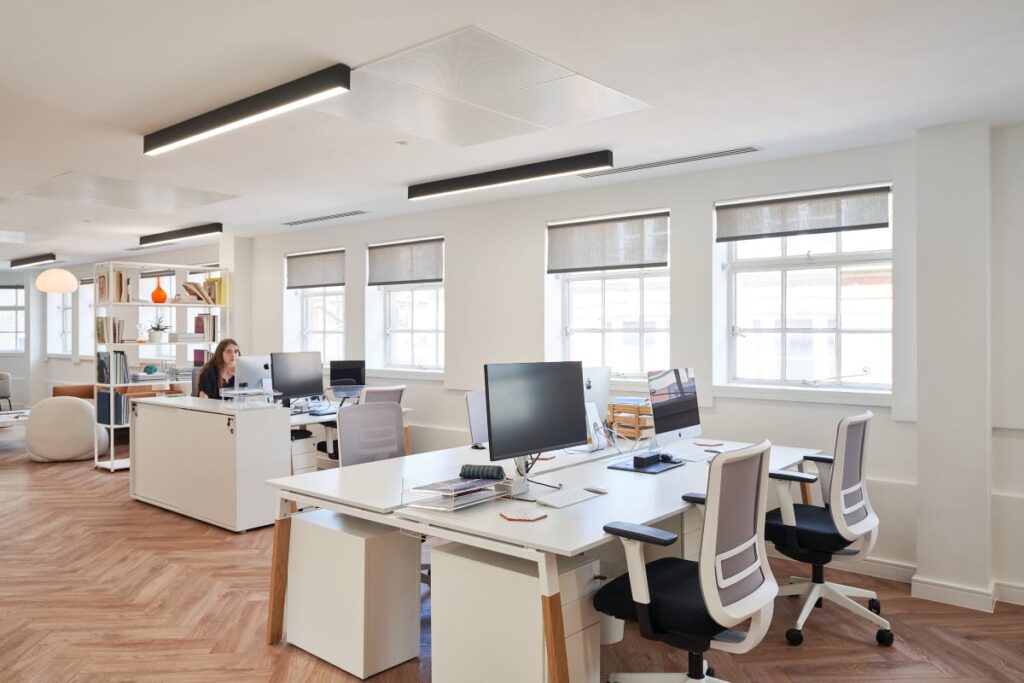
Material and aesthetic choices carry temporal weight that designers sometimes underestimate. The exposed brick and reclaimed timber that appears contemporary today will look period-specific within years, dating workspace in ways that undermine professional perception.
Future-proof aesthetics favour timeless materials and proportions over fashionable statements that announce their vintage uncomfortably quickly. Quality materials age well; trendy ones simply age. Good proportions remain satisfying regardless of stylistic fashion. Flexibility to update surface treatments without affecting underlying design allows refreshment without reconstruction.
Planning for Expansion Before You Need It
Business growth often creates space requirements that exceed initial projections, which makes expansion potential worth considering even during initial occupation. Workspace that cannot accommodate growth forces businesses into premature relocation or awkward multi-site operations that fragment culture and complicate management.
Negotiating options on neighbouring space, selecting buildings with expansion capacity, designing fit-outs that can extend into adjacent areas without complete reconstruction – these provisions might never be exercised, but having addressed the possibility prevents expansion from becoming an unmanageable problem should growth exceed projections.
The Long View on Workspace Investment
The question isn’t whether your business will evolve but whether your workspace can evolve with it. Soul Spaces operates as a London commercial office build and renovation team experienced in creating environments that remain functional across business cycles, understanding that design decisions should balance immediate requirements against long-term adaptability.
Workspace designed with adaptability as a core principle – infrastructure over-specified, flexibility embedded, sustainability exceeding current minima, aesthetics favouring timelessness over trend – ages considerably better than spaces optimised purely for current requirements. The modest additional investment typically proves far cheaper than the disruptive refurbishment or premature relocation that rigid design necessitates when circumstances inevitably change. Future-proofing ultimately recognises that change represents the only certainty worth designing for.
Ready to find your dream office?