
How Office Space Layout Benefits Company Culture
Company culture doesn’t emerge from mission statements or team-building exercises nearly as much as organisations suppose. It forms through daily patterns – how people interact, where collaboration happens, which behaviours get reinforced through environmental cues, what the physical space makes easy or difficult. Office layout shapes these patterns more profoundly than most businesses acknowledge when making spatial decisions primarily on cost or density grounds. The workspace that emerges from purely economic calculations might save money per square foot whilst undermining the cultural qualities that actually drive organisational performance.
This relationship between layout and culture operates largely unconsciously. People don’t typically articulate how spatial arrangements affect their behaviour; they simply respond to environmental cues in ways that compound over time into distinctive organisational patterns. Understanding this dynamic allows intentional design choices that reinforce desired culture rather than accidentally creating spaces that work against stated values whilst ostensibly serving them.
Collaboration Versus Autonomy
The first cultural dimension layout affects is the balance between collaborative and individual work. Open layouts with minimal separation explicitly favour interaction – making spontaneous conversation easy, keeping teams visibly connected, reducing barriers to communication. These arrangements suit cultures genuinely valuing collaboration, where knowledge-sharing and cross-functional work represent core operational principles rather than aspirational statements.
But collaboration-focused layouts impose costs on concentration-intensive work. The acoustic environment that enables easy conversation creates constant distraction for people attempting sustained focus. When your culture actually requires both deep individual work and collaborative interaction – as most organisations do – the layout needs to accommodate both modes rather than optimising solely for one. This typically means providing variety: open collaborative areas alongside quiet zones for concentration, informal discussion spaces distinct from formal meeting rooms, social areas separate from focused work environments.
The relationship between open-plan vs segmented office layouts and cultural outcomes reveals that successful layouts match spatial decisions to actual work patterns rather than imposing single arrangements across diverse requirements. Cultures claiming to value collaboration whilst providing no spaces that actually support it reveal gaps between stated and lived values. Similarly, organisations championing individual excellence whilst forcing everyone into open benching create environmental contradictions that undermine stated priorities.
Hierarchy Made Visible or Invisible
Layout decisions make organisational hierarchy either visible or obscured. Traditional arrangements with private offices sized and positioned according to seniority create explicitly hierarchical environments where spatial distribution maps directly onto organisational status. Open plans with minimal differentiation obscure hierarchy spatially, creating environments where formal rank proves less immediately obvious.
Neither approach is inherently superior; the question is alignment with actual culture. Organisations genuinely operating as flat hierarchies – where decisions emerge from expertise rather than position, where status matters less than contribution – benefit from layouts that reinforce these values spatially. Those with clear hierarchical structures that serve genuine operational purposes might find traditional arrangements more authentic than open plans that create false impressions of equality whilst maintaining rigid hierarchical practices.
The worst outcome is spatial arrangements that contradict operational reality – open plans in organisations that actually operate hierarchically, or private offices distributed by seniority in cultures claiming to be meritocratic and flat. These contradictions create cynicism that undermines cultural development more effectively than honest spatial arrangements that reflect actual rather than aspirational structures.
Chance Encounters and Network Formation
Spatial layout profoundly affects who encounters whom during ordinary workdays. Circulation patterns, break area locations, meeting room placement – these decisions determine which people naturally cross paths regularly versus which might work in the same building for months without meeting. These encounter patterns shape informal networks that often matter more for actual organisational functioning than formal reporting structures.
Layouts that facilitate diverse encounters – mixing departments around shared facilities, creating circulation that crosses organisational boundaries, positioning social spaces where different groups naturally intersect – build networks that span functional silos. This connectivity serves cultures prioritising cross-functional collaboration, innovation through diverse perspective combination, or knowledge-sharing across departmental boundaries.
Conversely, layouts that segregate departments spatially – each team isolated on separate floors or distinct areas – reinforce functional boundaries and limit spontaneous interaction across silos. This arrangement might suit cultures where deep functional expertise matters more than cross-pollination, but it works against any organisational aspiration toward integrated collaboration or boundary-spanning innovation.
Transparency and Information Flow
The degree of visual and acoustic transparency that a layout provides affects information flow and cultural assumptions about openness. Entirely open environments with glass meeting rooms and minimal visual barriers create cultures where work happens visibly, where observation represents the norm, where privacy requires explicit justification rather than being the default state.
More enclosed arrangements with solid walls and distinct private areas create cultures where work happens largely invisibly, where privacy represents the default, where sharing requires active choice rather than being environmentally enforced. Neither transparency level is universally better; the question is whether spatial decisions align with how your culture actually handles information and privacy.
Organisations requiring confidential work – legal practices, financial services, strategic consultancies – need layouts that make privacy practical rather than treating it as an exception requiring special arrangement. Those prioritising radical transparency might benefit from environments that make isolation difficult, reinforcing cultural norms around openness through spatial arrangements that make visibility the default condition.
Flexible Work and Cultural Continuity
The rise of hybrid working creates interesting cultural challenges around how layout supports culture when occupancy varies substantially. Some days see full attendance; others find offices sparsely populated. Traditional layouts optimised for consistent full occupancy struggle when usage fluctuates dramatically, creating either wasteful vacancy during quiet periods or uncomfortable overcrowding during peaks.
Layouts accommodating variable occupancy – through hot-desking, bookable spaces, areas that intensify or relax as attendance shifts – prevent the common problem where hybrid working creates spatial inefficiency that undermines both economic performance and cultural continuity. The key is maintaining cultural coherence across variable attendance patterns rather than allowing workspace to feel abandoned during quiet periods or uncomfortably dense during busy ones.
Social Infrastructure and Informal Culture
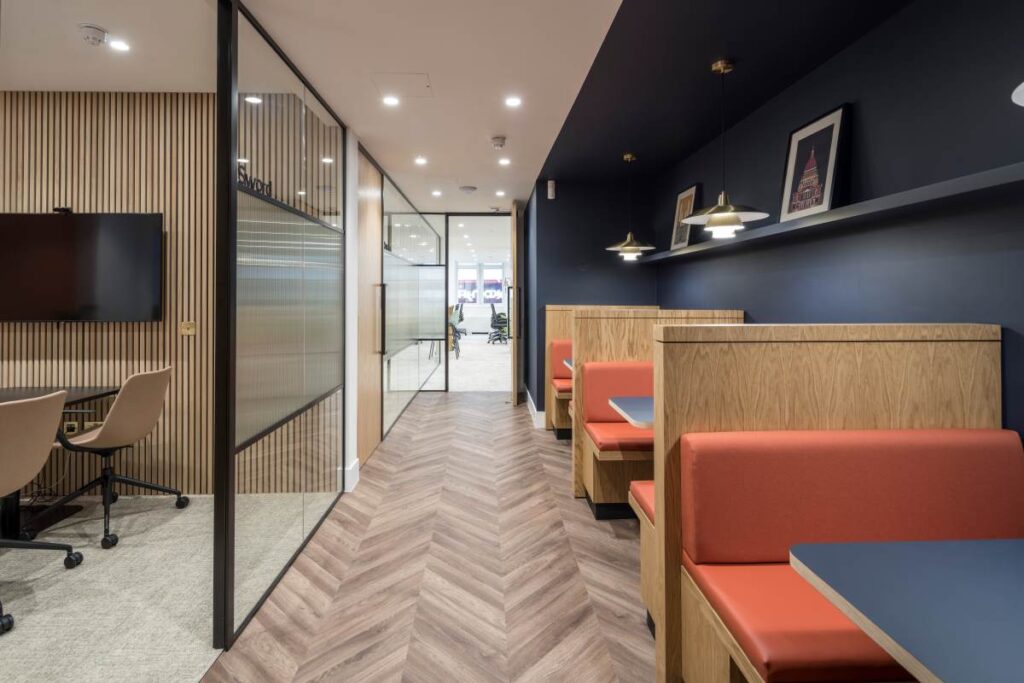
The informal dimensions of culture – how people interact socially, where relationships develop beyond purely professional transactions, what behaviours get normalised through casual interaction – depend substantially on social infrastructure within layouts. Quality break areas that encourage lingering. Comfortable informal meeting spaces. Kitchen facilities that facilitate spontaneous gathering. External spaces suitable for casual conversation.
These elements seem peripheral to primary workspace function but often determine whether cultures remain purely transactional or develop the relationship depth that characterises genuinely cohesive organisations. Layouts treating social infrastructure as afterthought or omitting it entirely for space efficiency create cultures that remain atomised regardless of collaborative aspirations, because the environmental conditions for relationship development simply don’t exist.
The Strategic Alignment Question
Soul Spaces works with organisations requiring bespoke corporate interior design and delivery that considers cultural implications alongside functional requirements. The approach recognises that layout decisions represent cultural decisions whether organisations acknowledge this explicitly or treat spatial planning as purely practical exercise.
The most effective layouts emerge when organisations examine desired culture honestly – not aspirational values but actual operational patterns they want to reinforce – and design spatial arrangements that support those patterns rather than accidentally undermining them. This requires moving beyond simple density calculations or aesthetic preferences to consider how different layout decisions affect daily interactions, information flow, hierarchy expression, and social infrastructure.
The Bottom Line
Office layout doesn’t determine culture entirely, but it shapes the environmental conditions within which culture forms and persists. Layouts aligned with desired cultural qualities reinforce those qualities through countless daily interactions. Those working against cultural aspirations create friction that undermines even sincere efforts at cultural development. The question isn’t whether layout affects culture but whether you’re making spatial decisions with cultural implications clearly understood or allowing them to emerge accidentally from decisions made on other grounds entirely.
Ready to find your dream office?