
How to Make Small Offices Feel Bigger: 7 Effective Tips

Updated: March 4th, 2026
Published: November 20, 2025
Square footage costs money. In London, particularly, office space represents one of the largest fixed expenses most businesses face. Small offices aren’t a compromise; they’re often a pragmatic necessity, especially for growing companies, startups, or organisations maintaining satellite locations.
The challenge isn’t the size itself; it’s making limited space function without feeling cramped, claustrophobic, or unprofessional. A poorly configured small office creates tangible problems: employee dissatisfaction, difficulty recruiting, reduced productivity. Fortunately, spatial perception is malleable. Design decisions can make identical square footage feel substantially larger or smaller.
Maximise Natural Light Access
Light transforms spatial perception more dramatically than almost any other variable. Rooms flooded with daylight feel expansive. The same dimensions under inadequate artificial lighting feel confined and oppressive.
Windows should never be obstructed by furniture, filing cabinets, or partitions. Workstations positioned near windows provide employees with daylight access whilst ensuring the light penetrates as far into the space as possible. Glass partitions, where privacy is needed, allow light to travel through the office rather than creating dark zones.
Mirrors, strategically positioned, can amplify natural light by reflecting it deeper into the space. A large mirror on a wall perpendicular to windows effectively doubles the perceived light source. Where natural light is limited, layered lighting – combining ambient, task, and accent sources – creates depth and dimension that flat overhead lighting cannot achieve.
Choose a Light Colour Palette
Dark colours absorb light. Light colours reflect it. In small spaces, this principle matters considerably.
White or pale neutral walls maximise light reflection, making rooms feel airier and more open. This doesn’t require stark minimalism. Texture, varied materials, and strategic accent colours prevent monotony whilst maintaining the light-reflective properties that expand perceived space.
Flooring contributes significantly. Light wood, pale carpet, or polished concrete in lighter tones all enhance brightness. Furniture follows the same logic – light-toned desks, chairs, and storage units recede visually, whereas dark furniture appears heavier and more dominant. Ceilings painted white or in the lightest available shade create the illusion of height.
Embrace Vertical Storage Solutions
Floor space is finite. Vertical space, by contrast, often goes underutilised in small offices.
Tall shelving units, wall-mounted storage, and cabinets that extend to ceiling height remove clutter from desks and floors whilst making use of otherwise wasted volume. This keeps the floor area open, which is critical for maintaining a sense of space.
Floating desks or wall-mounted work surfaces eliminate the visual bulk of traditional desk legs, creating a lighter aesthetic. Vertical filing systems, pegboards, and wall-mounted organisers keep supplies accessible without consuming precious desk or floor area. Built-in solutions, where feasible, integrate storage into the architecture rather than adding freestanding furniture.
Select Appropriately Scaled Furniture
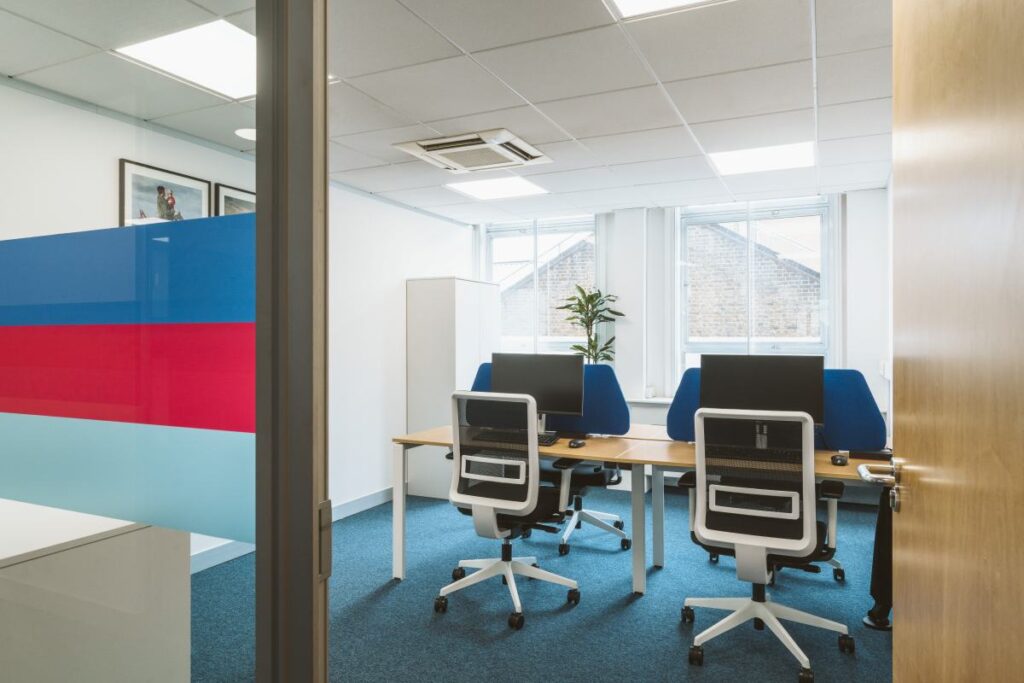
Oversized furniture overwhelms small spaces. A massive conference table, expansive executive desk, or bulky seating creates visual congestion regardless of how the rest of the room is designed.
Furniture should be proportional to the space it occupies. Slimmer desks, compact chairs, and modular pieces that can be reconfigured as needed maintain functionality without dominating the room. Transparent or semi-transparent materials – glass desktops, acrylic chairs – allow light and sightlines to pass through, reducing visual weight.
Multi-functional furniture increases utility without increasing footprint. Desks with integrated storage, benches that double as filing systems, or tables that fold away when not needed all maximise the value extracted from limited square footage. Leggy furniture, with visible space beneath, feels lighter than pieces that sit flush with the floor.
Minimise Visual Clutter
Clutter contracts space. An office scattered with papers, equipment, cables, and miscellaneous items feels smaller than the same space when organised and streamlined.
Cable management eliminates one of the most pervasive sources of visual chaos. Cables routed through desk grommets, secured along walls, or concealed in cable trays disappear from view. Closed storage hides the visual noise of files, supplies, and personal items. Digital solutions reduce physical presence – cloud storage, digital document management, and electronic workflows eliminate filing cabinets and paper storage that consume both floor space and visual bandwidth.
Regular audits of what actually needs to be in the office often reveal substantial volumes of redundant equipment or items kept “just in case” that never get used. Removing them immediately expands usable space.
Define Zones Without Solid Partitions
Small offices still require functional separation – areas for focused work, collaboration, phone calls, or informal conversation. Solid walls or floor-to-ceiling partitions, however, fragment the space and eliminate sightlines that contribute to perceived openness.
Low partitions, around desk height, provide acoustic and visual separation without completely dividing the room. Furniture arrangement can delineate areas without physical barriers – a cluster of chairs around a small table creates a distinct meeting zone. Rugs, changes in flooring material, or subtle shifts in lighting define zones whilst preserving visual continuity. Plants, strategically positioned, act as organic dividers whilst remaining visually light and permeable.
Remove What Isn’t Essential
Physical removal of unnecessary items transforms how space functions and feels. Shared resources – printers, supplies, reference materials – can often be consolidated rather than duplicated across desks. Going paperless wherever possible eliminates the physical footprint of documents and filing systems. Furniture that no longer serves its purpose should be removed, not retained out of inertia.
Getting It Right From the Start
At Soul Spaces, we support businesses through every stage of their workspace journey. As tenant representatives, we help you find office space that actually suits your needs, evaluating properties not just on location and price but on whether they can genuinely support how your business operates. We negotiate better terms than you’d secure independently – our clients regularly achieve 12.5% to 40% reductions on headline rents – and we ensure lease agreements don’t prevent the modifications you’ll need to make the space work properly.
Once you’ve secured the right space, our design and build team translates your requirements into functional, inspiring environments. We’ve worked with everyone from healthcare companies to creative agencies, tech firms to media production houses, always designing for how each business actually functions rather than applying generic solutions.
So whether you need a complete fit-out in five weeks or a thoughtful refurbishment, our tailored office solutions overseen by experts handle the entire process – so you can focus on running your business.

Ready to find your dream office?