
The Psychology of Office Design

Updated: March 4th, 2026
Published: November 17, 2025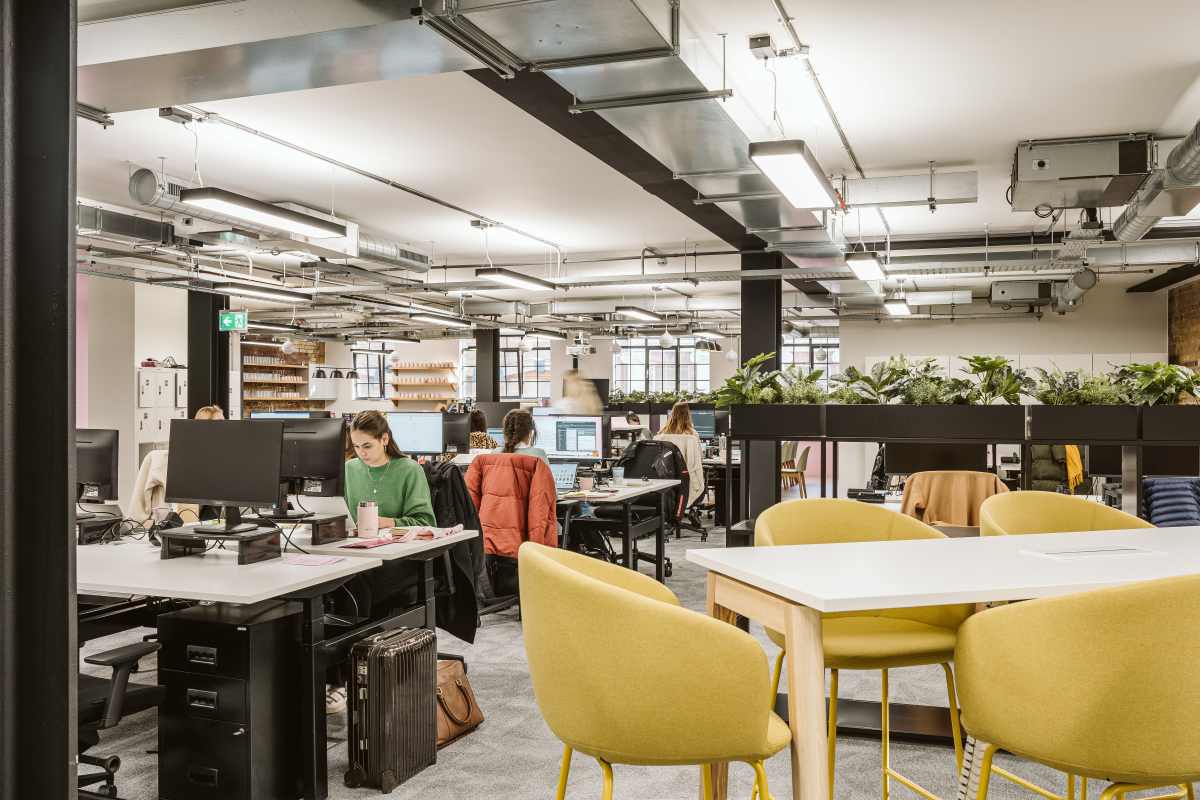
In 1943, Abraham Maslow published his hierarchy of needs: a pyramid that placed physiological requirements at the base and self-actualisation at the apex. What he didn’t anticipate was how profoundly the spaces we inhabit would influence our ability to ascend those tiers. Office design, it turns out, is far more than an aesthetic exercise or a branding opportunity. It operates on the psyche in ways both overt and insidious, shaping cognition, mood, and interpersonal dynamics whether occupants realise it or not.
The Open-Plan Paradox
The open-plan office became ubiquitous in the latter half of the twentieth century, under the premise that visual openness would foster collaboration. Research tells a different story. A 2018 study from Harvard Business School found that removing spatial boundaries actually reduced face-to-face interaction by approximately 70%, with employees retreating into digital communication to preserve concentration and privacy. In short, an environment designed to bring people together drove them further apart.
This paradox reveals something fundamental about how humans process their surroundings. Environmental psychologists have long understood that the brain requires a delicate balance between stimulation and refuge. Too much exposure creates cognitive overload; too much isolation breeds disengagement. Offices that fail to account for this duality – favouring either extreme transparency or cellular rigidity – inevitably suffer from diminished productivity and elevated stress.
The Neuroscience of Colour
Colour alone exerts measurable influence. Blue tones have been shown to enhance focus and analytical thinking, which is why financial institutions and law firms often incorporate them into meeting rooms and workstations. Warmer hues – reds, oranges, yellows – stimulate creativity and energy but can induce anxiety if overused. Green, unsurprisingly, reduces eye strain and promotes calm, making it ideal for spaces where employees spend prolonged periods staring at screens. These aren’t subjective preferences. They’re neurological responses rooted in how the human visual cortex interprets wavelength and saturation.
Sociopetal and Sociofugal Spaces
Spatial configuration matters just as much. British psychologist Humphry Osmond coined the term “sociopetal” in the 1950s to describe environments that encourage interaction, contrasting them with “sociofugal” spaces that discourage it. A breakout area with soft seating arranged in clusters is sociopetal. Rows of desks facing a wall are decidedly sociofugal. Most offices contain both, though rarely by deliberate design. The result is a workplace that sends conflicting signals about what behaviours are valued, leaving employees to navigate an environment that simultaneously invites collaboration and punishes it with noise and distraction.
Ceiling Height and Cognitive Function
Height and volume also have psychological implications that often go unconsidered. High ceilings promote abstract thinking and creativity, according to research published in the Journal of Consumer Research. Lower ceilings, conversely, encourage detail-oriented work and focus. An office designed with uniform ceiling heights across all zones misses an opportunity to align physical space with cognitive demands. The same principle applies to acoustics: persistent background noise – printers, conversations, HVAC systems – aren’t just annoying, but can degrade working memory and increase cortisol levels.
Natural Light and Circadian Rhythms

Another aspect that merits particular attention is natural light. Circadian rhythms, which regulate sleep-wake cycles and hormone production, depend on exposure to daylight. Offices that rely exclusively on artificial lighting disrupt these rhythms, contributing to fatigue, mood disorders, and decreased immune function. A study conducted by Cornell University found that workers seated within ten feet of a window reported an 84% reduction in eyestrain, headaches, and blurred vision compared to those in windowless environments. The economic implications are considerable: absenteeism drops, healthcare costs decline, and retention improves.
Biophilic Design
Biophilic design – the integration of natural elements into built environments – extends beyond windows. Indoor plants, natural materials like wood and stone, even the presence of water features have been linked to lower blood pressure and improved cognitive performance. It’s pretty simple: humans spent millennia in natural settings; our brains are wired to find them restorative.
The Importance of Control
Control, or the perception of it, may be the most underestimated factor in office psychology. Employees who can adjust their lighting, temperature, or seating position are more likely to report higher job satisfaction and lower stress than those who cannot. Autonomy, even in small doses, signals respect and trust, while its absence communicates the opposite. Open-plan offices often strip workers of control entirely, leaving them unable to manage noise, temperature, or visual distractions.
Territoriality and Hot-Desking
Then there’s territoriality, a concept borrowed from ethology – the study of animal behaviour. Humans, like most species, have an innate need to claim and personalise space. Hot-desking policies, which eliminate assigned workstations in favour of shared seating, violate this instinct. While proponents argue such arrangements increase flexibility and reduce real estate costs, they often fail to account for the stress induced by perpetual displacement. Employees without a physical anchor in the office experience lower engagement and higher turnover.
The Hybrid Work Challenge
The rise of hybrid work has complicated these dynamics further. Offices are no longer spaces people inhabit daily; they’re destinations chosen for specific purposes – collaboration, mentorship, social connection. This shift demands a rethinking of design priorities. Spaces optimised for individual focused work may no longer justify their square footage. Instead, the emphasis must move towards environments that facilitate what cannot be replicated remotely: spontaneous conversation, creative problem-solving, and the intangible sense of belonging that comes from shared physical presence.
Workspace as Active Participant
What becomes clear is that office design is not neutral. Every choice – from furniture arrangement to material selection to lighting quality – carries psychological weight. Most companies approach office searches by browsing listings without understanding how spatial decisions will affect their workforce – does the ceiling height support the kind of thinking your team does, will the floor plate allow adequate daylight penetration, can the layout accommodate both collaboration and concentrated work?
At Soul Spaces, we evaluate offices through this lens, assessing whether a space will actually function for how your people work. We identify structural limitations that will create problems later, and negotiate lease terms that allow necessary modifications. With our expert help securing the right workspace, these considerations shape the search from the beginning, not after you’ve already signed a lease.
Sources:
Bernstein, E.S. and Turban, S. (2018). “The impact of the ‘open’ workspace on human collaboration,” Philosophical Transactions of the Royal Society B: Biological Sciences, 373(1753).
Meyers-Levy, J. and Zhu, R. (2007). “The Influence of Ceiling Height: The Effect of Priming on the Type of Processing That People Use,” Journal of Consumer Research.
Hedge, A. (2018). “Daylight & The Workplace Study,” Cornell University Department of Design and Environmental Analysis.

Ready to find your dream office?